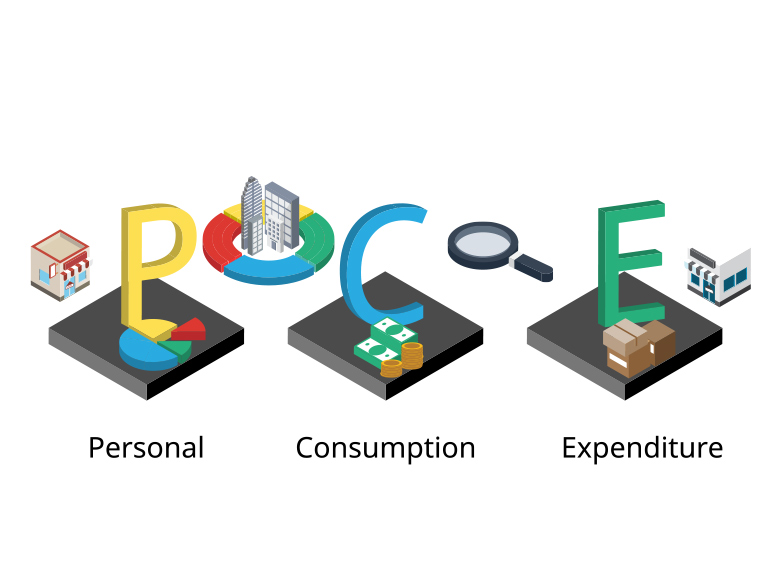
Personal Consumption Expenditures (PCE): What It Is and Why the Fed Tracks It

Personal Consumption Expenditures (PCE) have become the Federal Reserve's preferred measure of inflation. As the primary metric influencing interest rate decisions, understanding PCE is essential for investors, businesses, and consumers navigating today's economic landscape.

PCE blocks with calculator

TL;DR: Key Takeaways

  • What PCE Measures: Total U.S. consumer spending on goods and services, representing approximately two-thirds of GDP

  • Fed's Preference: The Federal Reserve favors PCE over the Consumer Price Index (CPI) for monetary policy decisions due to its broader coverage and dynamic weighting

  • Release Schedule: Published monthly by the Bureau of Economic Analysis, typically on the last Friday of each month

  • Market Impact: PCE data directly influences Federal Reserve interest rate decisions, affecting everything from mortgages to investment returns

The Three Categories of PCE

The BEA divides PCE into three primary classifications:

  1. Durable Goods Long-lasting items with a lifespan exceeding three years, including motor vehicles, furniture, appliances, and electronic equipment.

  2. Non-durable Goods Short-lived commodities are typically consumed within three years, including food, beverages, clothing, fuel, and pharmaceuticals

  3. Services Intangible economic activities that benefit consumers, encompassing healthcare, housing, transportation, financial services, and recreation. 

What Is the Bureau of Economic Analysis (BEA)??

The Bureau of Economic Analysis operates as an independent statistical agency within the U.S. Department of Commerce. Established in 1972, the BEA collects, analyses, and publishes comprehensive economic data that informs both government policy and private sector decision-making.

Beyond PCE figures, the BEA calculates critical metrics including Gross Domestic Product (GDP), international trade balances, and regional economic statistics. Its data undergoes rigorous quality controls and peer review processes to ensure accuracy and reliability.

Why Is PCE Important to the Economy?

Personal Consumption Expenditures hold outsized significance in economic analysis for several interconnected reasons:

Economic Growth Driver

Consumer spending accounts for approximately 68% of U.S. GDP, making it the most significant single component of economic activity. When the PCE rises, it typically signals economic expansion; a declining PCE often presages a recession.

Inflation Measurement

The PCE Price Index tracks price changes across consumer goods and services, providing the Federal Reserve's primary inflation gauge. The central bank formally adopted a 2% PCE inflation target in 2012 to maintain price stability whilst supporting maximum employment.

Business Planning Tool

Companies utilise PCE data to forecast consumer demand, adjust inventory levels, and make strategic hiring and investment decisions. A retail chain, for instance, might expand operations when spending on services shows sustained growth, or a manufacturer might increase production when durable goods purchases accelerate.

Policy Foundation

Policymakers rely on PCE trends to evaluate the effectiveness of fiscal stimulus programmes, assess economic inequality, and determine appropriate monetary policy responses

How Is the PCE Calculated?

The BEA employs a comprehensive methodology to calculate PCE, drawing data from multiple authoritative sources:

Data Sources

  • Business Surveys: The Census Bureau's Service Annual Survey and Quarterly Services Survey

  • GDP Components: National Income and Product Accounts data

  • Trade Organisations: Industry-specific expenditure reports

  • Government Statistics: Medicare, Medicaid, and other public programme expenditures

Calculation Process

  1. Aggregate Spending: The BEA totals all consumer expenditures across durable goods, non-durable goods, and services

  2. Price Adjustment: Current-dollar figures are adjusted using chain-type price indices to calculate "real" (inflation-adjusted) PCE

  3. Weight Assignment: Each category receives a weight based on its share of total spending, with these weights updated quarterly to reflect changing consumption patterns

  4. Index Creation: The PCE Price Index uses a baseline year (currently 2017=100) to track price changes over time

This dynamic weighting methodology distinguishes PCE from the fixed-basket approach used by the Consumer Price Index, enabling PCE to more accurately reflect substitution effects when consumers adjust their purchases in response to price changes.

When Is the PCE Released?

The Bureau of Economic Analysis publishes PCE data according to a strict timetable designed to provide timely economic insights:

Monthly Release Schedule

PCE figures are included in the Personal Income and Outlays report, released on the last Friday of each month at 8:30 a.m. Eastern Time.

Report Components

Each monthly release includes:

  • Personal income levels and growth rates

  • Personal consumption expenditures (current and inflation-adjusted)

  • Personal saving rate

  • PCE Price Index (headline and core)

  • Detailed breakdowns by goods and services categories

Market Significance

Financial markets closely monitor PCE releases, particularly the core PCE Price Index figure. Deviations from economists' forecasts often trigger volatility in equities, bonds, and currency markets as traders reassess their expectations of Federal Reserve policy.

PCE and Inflation: What Different Levels Indicate

PCE inflation readings offer valuable insights into economic health and future policy direction:

Rising PCE (Above 2% Target)

Signals:

  • Strong consumer demand potentially outpacing supply

  • Risk of economic overheating

  • Declining purchasing power

Federal Reserve Response:

Likely to maintain or increase interest rates to cool demand and bring inflation towards the target.

Declining PCE (Below 2% Target)

Signals: 

  • Weakening consumer demand

  • Potential deflationary pressures

  • Economic slowdown risk

Federal Reserve Response:

May reduce interest rates to stimulate borrowing, spending, and investment, supporting economic growth.

Stable PCE (Near 2% Target)

Signals:

  • Balanced supply and demand

  • Price stability

  • Healthy economic conditions

Federal Reserve Response:

Typically maintains current policy settings, allowing the economy to grow at a sustainable pace.

How Does the Federal Reserve Use PCE?

The Federal Reserve's preference for PCE over alternative inflation measures stems from methodological advantages that enhance policy precision.

Why the Fed Prefers PCE to CPI

In February 2000, the Federal Reserve formally announced its focus on the PCE Price Index, later setting an explicit 2% target in January 2012. This preference reflects several key factors:

1. Comprehensive Coverage

PCE captures a broader range of expenditures, including healthcare services paid by employers and government programmes on behalf of consumers, costs that affect the economy even though individuals don't pay directly.

2. Dynamic Weighting

PCE weights adjust quarterly based on actual spending patterns, accurately reflecting substitution effects. When beef prices rise sharply, for example, consumers might switch to chicken, and PCE weights adapt accordingly.

3. Methodological Consistency

PCE data integrates directly with GDP calculations, providing consistency across economic measurements and facilitating more accurate forecasting.

4. Lower Volatility

Historical analysis indicates that PCE inflation typically runs approximately 0.3 percentage points lower than CPI inflation, primarily due to differences in weighting, which provides a more stable policy foundation.

Policy Implementation

The Federal Open Market Committee (FOMC) reviews PCE data at each of its eight annual meetings when setting the target for the federal funds rate. Recent statements emphasise the Committee's commitment to returning inflation to 2% over time, with September 2025 projections showing PCE inflation moderating to 2.3% by year-end and reaching the target by 2027.

Practical Example

Consider a scenario where beef prices increase by 15% whilst chicken prices remain stable. A consumer might shift from purchasing beef to chicken to maintain their budget.

  • CPI Response: Continues to measure the original beef-heavy basket, showing higher inflation because it assumes consumers continue to buy expensive beef.

  • PCE Response: Adjusts weights to reflect the shift toward chicken, showing lower inflation that more accurately represents actual consumer costs.

Which Should You Monitor?

  • For investors, PCE matters most because it drives Federal Reserve decisions that affect interest rates, bond yields, and equity valuations.

  • For Wage Negotiations, CPI often serves as the benchmark because it measures direct out-of-pocket costs and doesn't include substitution effects.

  • For economic analysis, both provide valuable perspectives: PCE for policy implications and CPI for consumer experience.

Advantages and Limitations of PCE Data

Advantages

Comprehensive Economic Overview

PCE provides the broadest measure of consumer activity, capturing approximately 68% of economic output. This comprehensive view makes it invaluable for assessing overall economic health.

Policy Relevance

As the Federal Reserve's preferred inflation gauge, PCE data directly influences monetary policy decisions that ripple through financial markets, affecting everything from mortgage rates to corporate borrowing costs.

Dynamic Methodology

Quarterly weight updates ensure PCE accurately reflects evolving consumer preferences and substitution behaviours, maintaining relevance in a changing economy.

Business Intelligence

Detailed categorical breakdowns enable companies to identify sector-specific trends, informing product development, marketing strategies, and expansion plans.

Limitations

Revision Frequency

PCE data undergoes regular revisions as additional source information becomes available. Initial estimates may differ substantially from final figures, occasionally leading to policy decisions based on incomplete data.

Data Lag

The two-month reporting delay means PCE figures may not capture the most current economic conditions, particularly during rapidly changing circumstances.

Incomplete Picture

PCE focuses exclusively on consumption, excluding other economic dimensions such as:

  • Investment spending

  • Government expenditures

  • Net exports

  • Income distribution

  • Quality-of-life measures

  • Category Exclusions

The Core PCE intentionally excludes food and energy categories that significantly impact household budgets, potentially underestimating inflationary pressures felt by consumers.

Survey Limitations

Reliance on business surveys introduces potential inaccuracies due to reporting errors, sampling limitations, and methodological changes that can affect data consistency over time.

Conclusion

Personal Consumption Expenditures serve as a cornerstone measure of U.S. economic health, consumer behaviour, and inflationary pressure. As the Federal Reserve's preferred inflation gauge, PCE data directly shape monetary policy decisions affecting interest rates, investment returns, and economic growth trajectories.

Understanding this indicator becomes increasingly critical for investors, businesses, and consumers navigating an evolving economic landscape. Whilst PCE provides invaluable insights, comprehensive financial analysis requires examining multiple data sources, recognising the limitations inherent in any single metric, and maintaining awareness of the dynamic interplay between consumption, inflation, and monetary policy.

As global economic conditions continue evolving, monitoring PCE trends alongside other key indicators will remain essential for making informed financial decisions and anticipating policy shifts.

*Past performance does not reflect future results. The above are only projections and should not be taken as investment advice. 

FAQs:

What does PCE stand for?

PCE stands for Personal Consumption Expenditures, representing the total value of goods and services purchased by U.S. consumers and those acting on their behalf.

How often is PCE data released?

The Bureau of Economic Analysis publishes PCE data monthly, typically on the last Friday of each month at 8:30 AM Eastern Time, covering figures from two months prior.

Why does the Federal Reserve prefer PCE over CPI?

The Fed favours PCE because it offers broader coverage of consumer spending (including imputed expenditures), uses dynamic weighting that captures substitution effects, integrates seamlessly with GDP calculations, and generally exhibits lower volatility than CPI (Federal Reserve, 2012).

What is core PCE, and why does it matter?

Core PCE excludes volatile food and energy prices to reveal underlying inflation trends unaffected by temporary supply shocks. The Federal Reserve focuses on core PCE to distinguish persistent inflation requiring policy response from transitory price movements.

Is high PCE good or bad for the economy?

Context determines impact. Moderate PCE growth (around 2-3% annually) signals healthy consumer demand supporting economic expansion. Excessive PCE growth may indicate overheating requiring policy intervention, whilst declining PCE can signal recession risk.

How does PCE affect interest rates?

Rising PCE inflation typically prompts the Federal Reserve to increase interest rates to cool demand and bring prices down. Conversely, falling PCE inflation may lead to rate cuts, stimulating economic activity.

What's the difference between real and nominal PCE?

Nominal PCE measures spending in current dollars, whilst real PCE adjusts for inflation to show the actual volume of goods and services purchased. Real PCE provides a more accurate picture of consumption trends by removing price effects.

Can businesses access detailed PCE data?

Yes. The BEA provides extensive supplementary tables breaking down PCE by detailed product categories, enabling sector-specific analysis. This data is freely available on the BEA website.

How reliable are initial PCE estimates?

Initial estimates provide generally accurate directional signals but frequently undergo revision as additional source data becomes available. Final estimates may differ from preliminary readings, particularly for recent months.

Where can I find historical PCE data?

The Federal Reserve Bank of St. Louis maintains comprehensive historical PCE data through its FRED (Federal Reserve Economic Data) database, offering downloadable series dating back to 1959.

Most recent articles

Related News & Market Insights


This information is written by Plus500 Ltd. The information is provided for general purposes only, and does not take into account any personal circumstances or objectives. Before acting on this material, you should consider whether it is suitable for your particular circumstances and, if necessary, seek professional advice. No representation or warranty is given as to the accuracy or completeness of this information. It does not constitute financial, investment or other advice on which you can rely. Any references to past performance, historical returns, future projections, and statistical forecasts are no guarantee of future returns or future performance. Plus500 will not be held responsible for any use that may be made of this information and for any consequences that may result from such use. Hence, any person acting based on this information does so at their own discretion. The information has not been prepared in accordance with legal requirements designed to promote the independence of investment research.